
Why LEO PM5 Motor Powers Smarter and More Efficient Commercial Pump Solutions
2026.06.12
Commercial pumping systems are under increasing pressure to reduce energy consumption, improve operational reliability, and support intelligent building management. Because the electric motor accounts for the majority of a pump's lifetime energy consumption, motor technology has become one of the most influential factors in total lifecycle performance.
LEO's PM5 permanent magnet motor combines IE5-level efficiency, integrated variable-speed control, intelligent protection functions, and compact mechanical design to help commercial pump systems operate more efficiently under varying load conditions. The result is lower operating costs, improved system stability, and a future-ready foundation for intelligent commercial buildings.
Commercial buildings are becoming more energy conscious than ever before. HVAC systems, domestic water supply, pressure boosting, and circulation systems are expected to deliver higher performance while consuming less electricity throughout their operating life.
At the same time, governments around the world continue tightening energy efficiency regulations, while owners increasingly evaluate equipment based on total lifecycle cost rather than initial purchase price alone.
These changes are transforming motor selection from a component decision into a system-level engineering decision.
Because pumps often operate thousands of hours every year, even modest improvements in motor efficiency can translate into significant reductions in electricity consumption over the service life of the equipment.
For engineers, selecting the right motor is therefore no longer simply about driving the pump—it is about improving the overall performance of the entire hydraulic system.
Although the hydraulic design determines how efficiently a pump moves water, the motor determines how efficiently electrical energy is converted into mechanical power.
An advanced motor contributes to:
- Higher overall pump efficiency
- Reduced electricity consumption
- Stable performance under partial-load operation
- Lower heat generation
- Reduced vibration
- Longer equipment life
- Improved compatibility with intelligent control systems
Since electricity typically represents the largest portion of a commercial pump's lifecycle cost, improvements in motor efficiency often provide greater long-term financial benefits than reductions in equipment purchase price.
Rather than relying on traditional induction motor technology, the LEO PM5 platform combines several engineering innovations into one integrated drive solution.
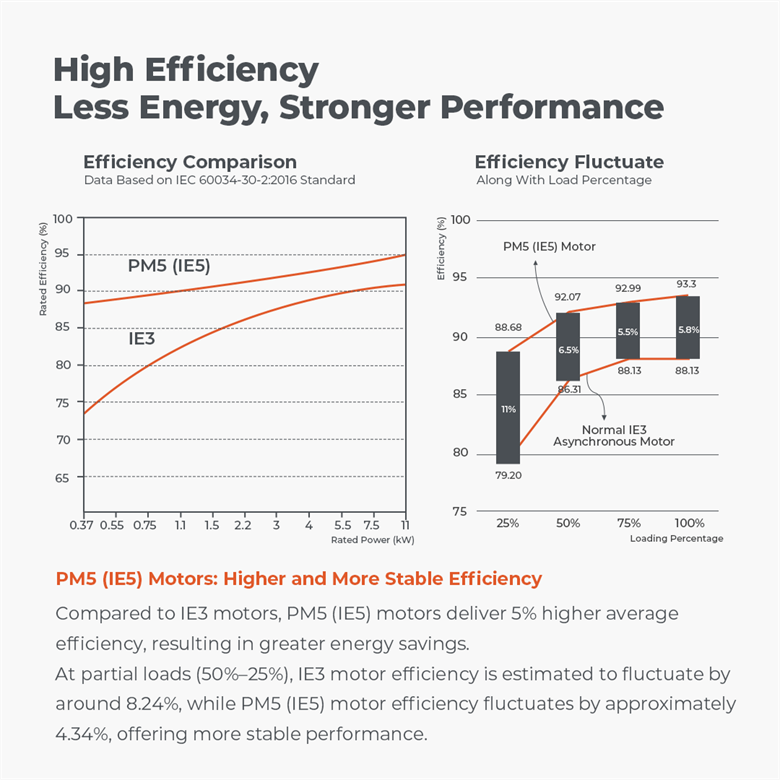
The PM5 adopts permanent magnet synchronous motor technology, which minimizes rotor losses and delivers significantly higher operating efficiency than conventional IE3 induction motors.
The high efficiency is maintained across a wide operating range, making the motor particularly suitable for variable-flow commercial pumping systems.
Instead of requiring a separate external inverter, the PM5 incorporates intelligent variable-speed control directly into the motor assembly.
This integration enables the pump to automatically adjust its speed according to changing system demand, reducing unnecessary energy consumption during partial-load operation.
Typical applications include:
- Variable water demand
- Pressure boosting
- HVAC circulation
- Secondary chilled water systems
The integrated structure reduces wiring complexity while simplifying installation.
For equipment manufacturers, this also helps reduce cabinet space requirements and overall system complexity.
The PM5 incorporates multiple protection mechanisms, including:
- Dry-running protection
- Over-current protection
- Over-voltage protection
- Low-voltage protection
- Phase loss protection
- Locked rotor protection
- Anti-freezing protection
- Communication protection
These built-in functions help reduce unexpected downtime while extending equipment service life.
The advantages of permanent magnet technology become even more apparent when applied across commercial building systems.
Demand varies continuously throughout the day.
The PM5 automatically adjusts motor speed to maintain stable pressure while minimizing unnecessary power consumption.
Cooling and heating systems frequently operate under partial-load conditions.
Variable-speed operation allows the motor to match actual system demand instead of continuously operating at full speed.
This improves seasonal energy efficiency while helping stabilize indoor environmental conditions.
Accurate speed regulation enables consistent outlet pressure despite fluctuating water consumption.
The result is improved user comfort together with reduced hydraulic stress on the system.
Hotels, hospitals, office buildings, schools, shopping centers, and mixed-use developments all benefit from:
- Lower operating costs
- Reduced maintenance requirements
- Improved equipment reliability
- Quieter mechanical rooms
- Better building energy performance
Energy efficiency is only one aspect of pump performance.
For building owners and facility managers, reliability and maintenance requirements often have an equally important impact on lifecycle cost.
The PM5 contributes through:
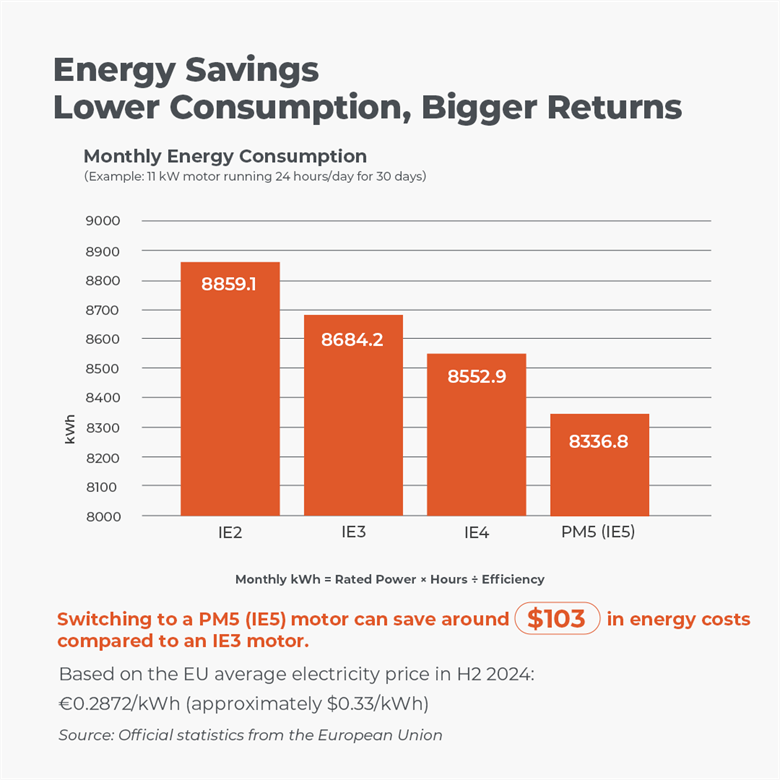
Higher motor efficiency reduces electricity consumption throughout the pump's operating life.
LEO's published data demonstrates that while the PM5 motor itself achieves an IE5-level nominal efficiency (up to 5% absolute efficiency increase over conventional IE3 motors) by eliminating rotor copper losses, its system-level energy savings can reach up to 40% under real-world variable load conditions, thanks to the precision speed control of the integrated VFD.
Integrated protection functions help minimize common causes of motor failure.
Reduced thermal stress also contributes to longer component life.
Permanent magnet motors provide smoother torque characteristics, helping reduce vibration and improve operational stability.
Improved motor efficiency and optimized control contribute to quieter operation—an important consideration for occupied commercial buildings.
Because pumps rarely operate continuously at full load, intelligent variable-speed control allows the complete pumping system to operate closer to its optimum efficiency point over a much greater proportion of its operating life.
| Feature | Conventional IE3 Induction Motor | LEO PM5 Permanent Magnet Motor |
|---|---|---|
| Motor Technology | Induction | Permanent Magnet Synchronous |
| Efficiency | IE3 | IE5-level |
| Variable Speed | External VFD required | Integrated VFD |
| Partial Load Performance | Moderate | Excellent |
| Rotor Loss | Higher | Lower |
| Intelligent Protection | Limited | Multiple integrated protections |
| Installation | More components | Compact integrated solution |
| Lifecycle Energy Consumption | Higher | Lower |
| Smart Building Compatibility | Basic | Excellent |
The commercial pumping industry is rapidly evolving toward intelligent, connected, and energy-optimized systems.
Several trends are accelerating this transition:
- Wider adoption of IE5 ultra-premium efficiency motors
- Greater integration of motors, drives, and digital controls
- Increased use of IoT-enabled monitoring
- Predictive maintenance through operational data
- Carbon reduction initiatives
- Digital building management systems
- Lifecycle-based equipment selection
As these technologies mature, high-efficiency permanent magnet motors will increasingly become a standard choice for commercial pumping applications rather than a premium option.
Motor technology is becoming one of the defining factors in commercial pump performance.
By combining permanent magnet efficiency, integrated variable-speed control, intelligent protection, and compact system design, the LEO PM5 Motor helps commercial pumping systems operate more efficiently, more reliably, and with lower lifecycle costs.
Rather than representing a single product upgrade, the PM5 reflects LEO's broader engineering approach—developing intelligent pump solutions that support sustainable buildings, optimized energy use, and long-term operational performance.
Hot Media


Strategic Dialogue o...
2026.03.30

LEO Brand Center Lau...
2026.03.23
LEO at Big 5 Global ...
2025.11.27
A Landmark LEO–Al Mo...
2025.12.02
LEO at the 138th Can...
2025.10.22
LEO Pro-Bono Water S...
2025.08.15

LEO PUMP 2024 Annual...
2025.05.14

A New Journey, A New...
2025.03.18

30 Years of LEO: lea...
2025.01.06

LEO at 30: United Th...
2024.12.16

A New Journey, A New...
2024.11.21

Showcasing Innovatio...
2024.10.25

LEO “Growing Forward...
2024.07.19
LEO Expands Global Q...
2024.09.06

LEO in Action: Power...
2024.08.02

LEO Event Highlight ...
2024.06.07
LEO PUMP at IFAT Mun...
2024.04.28
LEO PUMP at 135th Ca...
2024.04.01
LEO PUMP at MCE 2024...
2024.03.06
LEO PUMP at Big 5 Co...
2024.02.20
LEO PUMP at THE BIG ...
2023.11.16

LEO's Key Role in Wi...
2023.11.04
LEO at 134th Canton ...
2023.10.18
LEO PUMP at SNEC PV ...
2023.06.02

LEO Solution of Wate...
2022.09.28

LEO Project - Solar ...
2022.08.31

LEO Flagship Showroo...
2022.06.28

LEO Project on Power...
2022.06.22
Follow Us


LEO Headquarter:No.5 Building, Jingchen Fengqi Business Center, East Tanhua'an Road, Shangcheng District, Hangzhou, Zhejiang, 310000, P.R. China
Production Base:No.1, 3rd Street, East Industry Center, Wenling, Zhejiang, 317511, P.R.China
+86-576-8998 6360
www.leopump.com